
How to Make Your Events Carbon Neutral
Updated: Aug 4
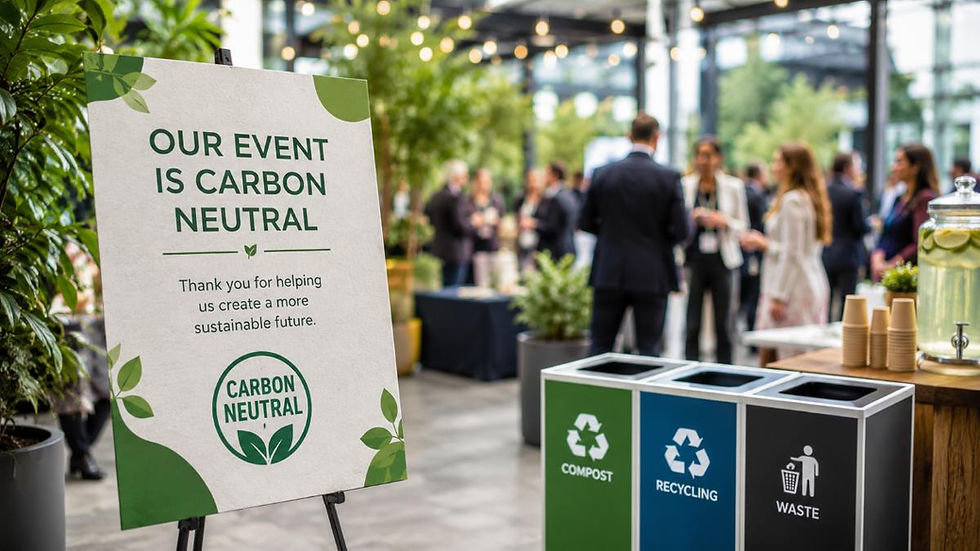
Sustainability has become a major priority for businesses planning corporate events. Clients, employees and stakeholders increasingly expect organisations to demonstrate environmental responsibility, and events are often one of the most visible opportunities to do so.
One term that appears frequently in sustainability discussions is "carbon neutral". It sounds straightforward enough, but many event organisers are unsure what it actually means or how to achieve it in practice.
The good news is that creating a carbon-neutral event is usually more achievable than people think. It does not require perfection, and it does not mean eliminating every source of emissions. Instead, it involves understanding where emissions come from, reducing them wherever possible and then addressing what remains through credible carbon offsetting.
Here's how to approach the process.
What Does Carbon Neutral Mean?
A carbon-neutral event is one where the greenhouse gas emissions generated by the event are balanced by actions that remove or offset an equivalent amount of carbon from the atmosphere.
In practical terms, this means calculating the emissions associated with the event, reducing those emissions where possible and then investing in verified offset projects to compensate for the remainder.
The goal is not to claim that the event produced no emissions. Rather, it is to ensure that any unavoidable emissions are balanced through measurable environmental action elsewhere.
This distinction matters because many sustainability claims fail when organisations focus exclusively on offsetting without first attempting to reduce their environmental impact.
Start by Measuring Your Event's Carbon Footprint
Before you can reduce emissions, you need to understand where they are coming from.
For most corporate events, the largest sources of emissions typically include:
Delegate travel
Venue energy consumption
Accommodation
Catering
Event production and materials
Freight and logistics
Waste disposal
Many organisers are surprised to discover that attendee travel often represents the biggest contributor to an event's carbon footprint. A conference with hundreds of delegates travelling long distances can generate far more emissions through transport than through venue operations.
Carbon footprint calculators and sustainability consultants can help estimate emissions across these areas, providing a baseline from which improvements can be made.
Without measurement, it becomes difficult to know where your efforts will have the greatest impact.
Reduce Travel Emissions Wherever Possible
Because travel is often the largest source of emissions, it should be one of the first areas to address.
Choosing venues with strong public transport connections can significantly reduce reliance on private vehicles. Central locations near rail stations often provide a lower-carbon alternative to venues that require extensive car travel.
For national or international events, hybrid participation options can also reduce emissions by allowing some attendees to join remotely.
When air travel is unavoidable, consider whether multiple trips can be consolidated or whether key participants genuinely need to travel in person.
Small changes to travel planning can have a surprisingly large impact on overall event emissions.
Choose a Sustainable Venue

Venue selection plays a major role in determining the environmental performance of an event.
Look for venues that have implemented sustainability initiatives such as:
Renewable energy sourcing
Energy-efficient lighting and heating systems
Waste reduction programmes
Water conservation measures
Sustainable procurement policies
Environmental certifications
A venue that actively manages its environmental impact can help reduce emissions without requiring additional effort from attendees.
Many venues now publish sustainability information that can help organisers make more informed decisions during the selection process.
Make Catering More Sustainable
Food production contributes significantly to global greenhouse gas emissions, which means catering choices can influence the carbon footprint of an event.
One of the most effective strategies is to increase the availability of plant-based options. Plant-based meals generally require fewer resources and generate lower emissions than meat-heavy alternatives.
Sourcing ingredients locally and seasonally can also reduce transport-related emissions while supporting local suppliers.
Food waste should be considered as well. Careful planning, realistic portion sizes and partnerships with food redistribution organisations can help prevent unnecessary waste after the event has finished.
Catering is often one of the easiest areas in which meaningful improvements can be made with little to no cost implications.
Reduce Materials and Waste
Events have traditionally generated large amounts of waste through printed materials, temporary signage, promotional items and single-use products.
Many of these materials can be reduced or eliminated altogether.
Digital event guides, mobile apps and online schedules can replace printed programmes. Reusable signage systems can reduce production waste.
Sustainable exhibition stands can be designed for repeated use rather than single-event disposal.
When physical materials are necessary, choosing recycled or responsibly sourced products can further reduce environmental impact.
The most sustainable material is often the one that never needed to be produced in the first place.
Work With Sustainable Suppliers
The environmental impact of an event extends beyond the venue.
Production companies, caterers, transport providers, printers and other suppliers all contribute to the event's overall carbon footprint. Choosing suppliers with clear sustainability policies can help reduce emissions throughout the supply chain.
Ask potential suppliers about their environmental practices. Do they monitor emissions? Do they use renewable energy? Have they implemented waste reduction initiatives?
These conversations not only improve sustainability outcomes but also encourage wider adoption of environmentally responsible practices throughout the events industry.
Offset Remaining Emissions Responsibly
Even after making substantial reductions, most events will still generate some unavoidable emissions.
This is where carbon offsetting comes in.
Carbon offsetting involves supporting projects that either remove carbon from the atmosphere or prevent emissions from occurring elsewhere. Examples include reforestation programmes, renewable energy projects and initiatives that improve energy efficiency in developing communities.
The quality of offset projects varies considerably, so it is important to use recognised and independently verified schemes. Transparency, accountability and measurable outcomes should all be considered when selecting offset providers.
Offsetting should always be the final step rather than the starting point.
Reducing emissions first ensures that carbon neutrality claims remain credible.
Communicate Your Sustainability Efforts
Attendees increasingly want to understand the environmental impact of the events they attend. Research found that more than one-third of event attendees consider transparency around sustainability to be a key factor in their decision-making, while nearly 700 surveyed attendees consistently ranked genuine environmental action and clear communication among their highest priorities.
Sharing sustainability goals and reporting outcomes can help demonstrate accountability while encouraging broader awareness. This might include publishing carbon footprint figures, outlining reduction measures or explaining how remaining emissions were offset.
Transparency is particularly important because it helps distinguish genuine environmental action from superficial sustainability messaging.
If your event falls short of certain targets, communicating those challenges honestly often builds more trust than pretending perfection has been achieved.
Carbon Neutrality Is a Journey, Not a Destination
One of the biggest misconceptions about carbon-neutral events is that they require a flawless sustainability strategy.
In reality, carbon neutrality is often achieved through a process of continuous improvement. Each event provides an opportunity to gather data, identify new reduction opportunities and strengthen sustainability performance over time.
The organisations making the greatest progress are rarely those trying to achieve perfection immediately. They are the ones consistently asking better questions and making more informed decisions with each event they deliver.
Businesses seeking bespoke company events designed for engagement are increasingly finding that sustainability and attendee experience can work hand in hand. Thoughtful planning can create events that are memorable, effective and environmentally responsible at the same time.
Better Planning Creates Lower-Carbon Events
Creating a carbon-neutral event is not about eliminating every source of emissions. It is about understanding where environmental impacts occur, reducing them wherever practical and taking responsibility for what remains.
By measuring emissions, improving travel choices, selecting sustainable venues, reducing waste, working with responsible suppliers and investing in credible carbon offsets, organisations can significantly reduce the environmental impact of their events.
As sustainability expectations continue to grow, carbon-neutral event planning is likely to move from a competitive advantage to a standard business practice. The organisations that begin making these changes now will be better positioned for that future.


